Monday, February 22, 2016

The Roosevelt Corollary


This cartoon is talking about how the Roosevelt Corollary made a larger impact on the Monroe Doctrine. The cartoonist’s message on this issue was the Roosevelt Corollary was the big amount of force that was applied to the Monroe Doctrine and that made the doctrine so much more powerful. The Europeans would probably believe that the doctrine is too forceful and makes the United States look like they are so preoccupied with filling our minds with the interests the United States have into Latin America. The Anti-Imperialist League people would also think that the United States has already gone too far with the Monroe Doctrine, but now adding the Roosevelt Corollary onto it, it is just an immoral doctrine now. Some of the techniques that were used in the cartoon was the labeling. The labeling was shown in a lot of places in the cartoon. The cannon was labeled the Monroe Doctrine, the claims were labeled from the envelope the King from a European country is holding, the European borders from the doctrine, the Latin American country, and the U.S. ship. The cannon that is labeled as the Monroe Doctrine represents that the United States will do anything and everything in its power to protect and defend Latin America from ANY intruders (mostly Europeans). As it is seen on the cartoon, the cannon is literally pointed at the European king while he is holding a “Claims” envelope he took from the Republic of Santo Domingo. Next, the European borders in front of the king specifically indicates that that is the division between the entire Western Hemisphere and Europe. The political cartoon supports my anti-imperialism position because of several reasons. Number one, the United States cannot just use military forces to necessarily “protect” the Latin America from the Europeans. Those actions would not seem very civil and that would be the wrong actions to take. Second, the United States cannot use force just because they want to defend their own interests. That reason that the United States is using is lacking with rationale because that looks like the U.S. is just greedy.  Lastly, the people from Latin America and the Europeans might already be in some type of trade or marketing industry together and the United States intervene in it all would not be a good idea. Those are the few reasons why the cartoon supports my position on anti-imperialism.

"The Roosevelt Corollary." Boundless.com. N.p., 21 July 2015. Web. 14 Feb. 2016. <https://www.boundless.com/u-s-history/textbooks/boundless-u-s-history-textbook/world-war-i-1914-1919-23/the-wilson-administration-176/the-roosevelt-corollary-960-2222/>.                         

The Spanish American War

CARTOON: PHILIPPINES, 1898. 
'It looks like a Merry Christmas for the Philippines.' American newspaper cartoon about aid sent to the Philippines during the U.S. occupation after the Spanish-American War. Wood engraving, December 1898.


This political cartoon is about how the Philippines are now a part of the United States after the Spanish American War.  The message the cartoonist was trying to say about the cartoon is that the Philippines will be able to obtain many of the “gifts” and benefits for being a part of the United States instead of being a separate country. It also looks like the cartoonist is also showing what the United States has to offer to the Philippines. Other people such as the Filipinos and the people from the Anti-Imperialist League would believe that the Philippines being a part of the United States is not what they truly want for Christmas. They would want to be a free and independence nation, not be a part of the United States even though there are all of those types of benefits they might get. The Anti-Imperialist League people would think that this would not be fair for the Philippines whatsoever because all they have ever wanted was independence, not the presents that they could get if they were a U.S. colony. That would not be fair at all for the United States to do that to the Philippines. The techniques used in the cartoon to make it persuasive would be the labeling and symbolism. The labeling technique is shown on the cartoon are the bags of presents that are all for the Philippines to have for Christmas. Each of the labeled bags from Santa represent a benefit that the Philippines will have as gifts from the United States because they are a U.S. colony. The bags are labeled from the words, justice, education, honest government, liberty, and prosperity. The flag that is on Santa’s sleigh says, “For the Philippines,” That shows that all of the labeled bags are ALL for the Philippines from the United States. There is symbolism in the cartoon because of Uncle Sam and Santa being there. First of all, Uncle Sam represents the United States and it shows that the U.S. is being portrayed in a good manner because Uncle Sam is helping Santa “pass” out presents to the Philippines. Santa is usually represented because he is the spirit of Christmas and gives out some kind of sign that it is a time where everybody gets to celebrate and be happy. This cartoon definitely supports my anti-imperialism position because it shows that even though there are gifts from the United States that the Philippines might get, but in the spirit of Santa and Christmas, what the Philippines truly want to celebrate is their independence. That makes this cartoon powerful and it will support my position.

Granger. "Cartoon: Philippines, 1898 by Granger." Fine Art America. N.p., n.d. Web. 14 Feb. 2016. <http://fineartamerica.com/featured/cartoon-philippines-1898-granger.html>.                         

The Roosevelt Corollary

tmp15B7_thumb_thumb
This cartoon is talking about how the United States had the Monroe Doctrine put up a notch because the U.S. added the Roosevelt Corollary to it. The message the cartoonist is trying to portray in the cartoon is that the United States is protecting Latin America and “blocking” it from the European countries as shown when one of the European men were looking through the binoculars. Other people at that time like the Europeans would think that the United States  could be too obsessed with expanding protecting their interests in Latin America. Some of the techniques used in this cartoon to make it persuasive would be the labeling and the symbolism. First of all, the labeling technique comes from the Monroe Doctrine being spelled out each of the ships. This shows that the Roosevelt Corollary added to the Monroe Doctrine would protect Latin America because of the U.S. Navy ships that are shown on the cartoon. Also, it shows symbolism because of the American flags on each of the ships and the Statue of Liberty purposely put in the background. The Statue of Liberty in this case might  represent the fact that the United States is doing this because they are “protecting” Latin America from the intruders like the European countries. The United States believe it is the right thing to do and that is what the U.S. stands for, liberty. I believe that this cartoon supports my position on anti-imperialism because even though protecting Latin America from intruders might be a positive thing, but the United States using their forces and power to protect its interests is not very reasonable. For instance, other countries from the Europeans might already had some alliances and connection with Latin America and now the United States is cutting that off too and that would not be fair. This is why I believe that this cartoon supports my anti-imperialism position.

Rivera, Harry Franqui. "The Roosevelt Corollary." N.p., n.d. Web. 14 Feb. 2016. <http://www.latinorebels.com/2014/12/22/american-hubris-and-the-ill-conceived-cuban-embargo/>.                         

The Open Door Policy

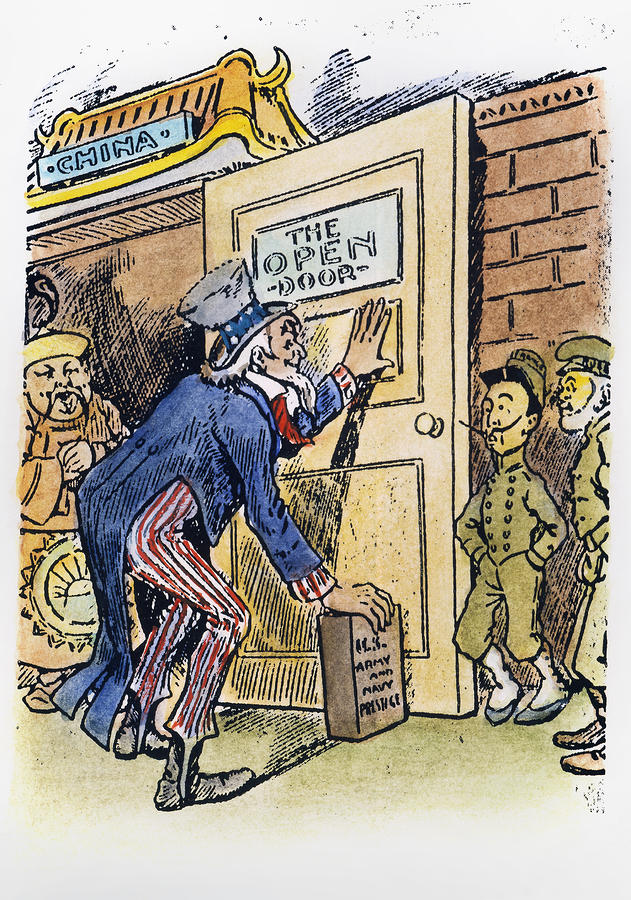
This cartoon is about China opening its doors to other countries. The cartoonist is trying to say that the other nations including the United States want to come into China to expand their influences as well. Other people’s opinions like the Anti-Imperialist League on this cartoon would be how the United States and the other countries are forcing China to open their doors just for the benefit of getting goods and expanding each of the countries’ sphere of influence. Some of the techniques used in the cartoon to make it persuasive is the symbolism in the cartoon. The symbolism is shown in the cartoon because of the door representing the Open Door Policy. It stands for the concept of how China never really “opened up” to other countries and it impacted the influences China had with other nations. Also, since Uncle Sam was kind of putting his hand on the “Door” and he was almost gesturing the Chinese in a way to come out and spread their influences among them. The people around Uncle Sam are probably also the representatives from the other countries that are involved in the Open Door Policy and joining the United States to get the Chinese to open their door. This cartoon supports my position of anti-imperialism because the outside countries like the United States and the European countries should not be intervening into China. It looked like that China did not even want to open up to the rest of the world yet and that is why the people in China were angry. For example, if some country went to intervene into the United States because of wanting to expand their influences, would the United States accept that? I would believe the United States would be angry exactly like how China was; that is also what caused the Boxer Rebellion. For those reasons, I think that this cartoon definitely supports my position on anti-imperialism.

“The Open Door Policy” Chappell, Caitlin. Blogspot.com. N.p., n.d. Web. 14 Feb. 2016. <http://cchappell2.blogspot.com/>.           

The Spanish American War

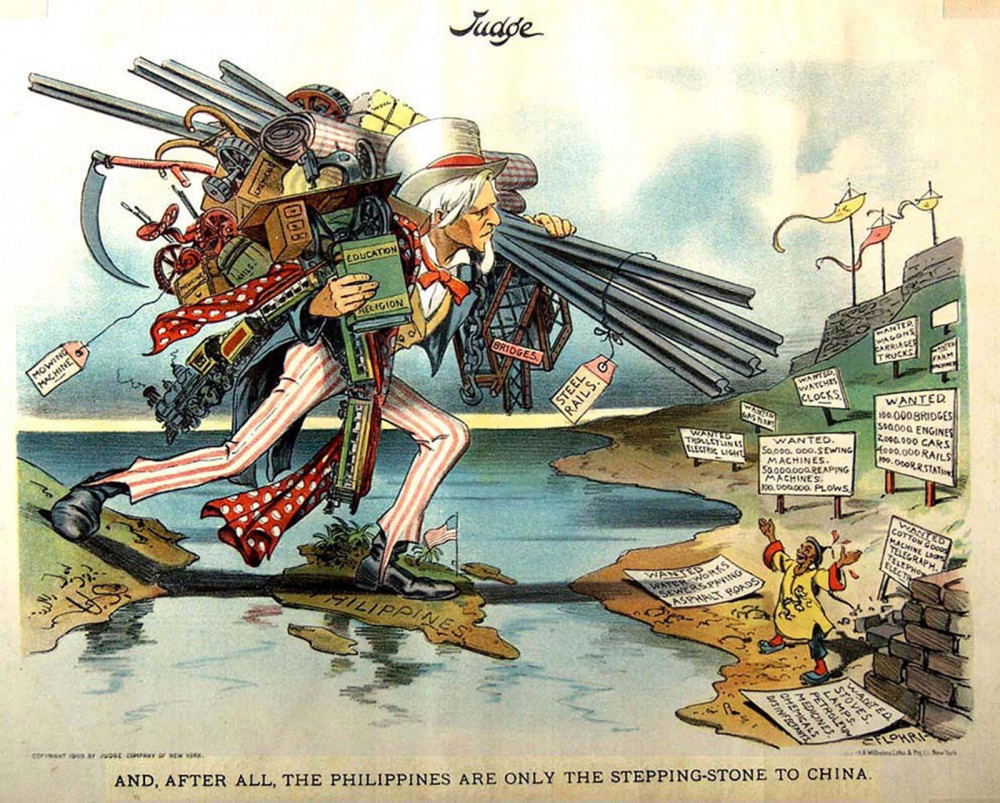
     This cartoon is talking about how the Spanish American War had a large effect on the Philippines and the United States. The cartoonist’s message was trying to say that the United States is using the Philippines as the final “support” in taking that “step” towards China. The United States just wanted to get to China where they could expand even more. The people like the Filipinos would probably be very furious and angry because the United States were technically using them as another step to being able to expand their influences to China. The Filipino people would feel like the United States didn’t care for their independence and justice and the United States took over the Philippines as a territory to have easier access to China. Also, the people from the Anti-Imperialist League would think that this action of “using” the Philippines to go and expand the U.S. influences into China would be absolutely immoral. The techniques used in this cartoon to make it persuasive is exaggeration and labeling. In the cartoon the exaggeration is shown by Uncle Sam being so large in size because he is representing the United States and since the U.S. has grown so “large” in expanding, it is shown by how large Uncle Sam is. The labeling is mostly shown on the cartoon because the items that Uncle Sam is carrying towards China are things that the United States would “give” in return when they would expand their influences toward China. Also, the land like the United States, Philippines, and China are labeled to represent the countries that are involved in the situation. The United States represents the idea of using the Philippines to expand influences into China. The Philippines are labeled because it is the country being the stepping stone to China. Lastly, China is labeled because that is what the United States is aiming towards to expanding. The cartoon supports my anti-imperialism position because it expresses that the United States technically fought along with the Philippines throughout the entire Spanish-American War just for their intention of using the Philippines later on to expand further into Asian countries. This supports the anti-imperialism side because this shows how the United States used the Philippines not because they truly wanted to help them, but do it for the United States' own benefit. Therefore, this cartoon helps defend my anti-imperialism position.

“The Spanish American War” Harris, Susan K. Americanyawp. N.p., n.d. Web. 14 Feb. 2016. <http://www.americanyawp.com/text/19-american-empire/>.                                

Saturday, February 20, 2016

The Panama Canal

The issue in this political cartoon is about how the United States needed to build a canal that could be useful for faster transportation from the Pacific Ocean to Atlantic Ocean. The cartoonist's message is trying to say that Teddy Roosevelt would do anything and everything he could to get Panama to be able to construct the canal. I would believe the Colombian people would be infuriated with this cartoon because it shows that the United States doesn't care about their opinion because Teddy Roosevelt is running over their protests and rules. I would also think the people like the Democrats at the time would strongly disagree with this cartoon because Roosevelt is breaking the laws and doing immoral things just because America can obtain Panama. The main techniques that are used to make the cartoon persuasive are labeling and symbolism. It first shows the labeling when Roosevelt was destroying everything that was labeled like the international law, Columbian protest, precedent, and treaty. He literally “ran over” all of those important matters because of the need of wanting Panama. There is also the Panama and Bust label which means that if Roosevelt will never stop and will do anything he can until he can obtain Panama. Those words there show a powerful sense of what Roosevelt will keep on persisting. There is the symbolism in the cartoon because the large elephant represents the Republican Party and that would appeal to Republicans who would be in favor of the idea. The cartoon definitely supports my anti-imperialism position because the cartoon shows that Teddy Roosevelt was ignoring everything and stomping over the rules because of the efficiency for the United States. That is surely not a good thing because it is not constitutional, immoral, and those acts are not what the United States stands for.

"The Panama Canal." Authentichistory. N.p., n.d. Web. 14 Feb. 2016. <http://www.authentichistory.com/1898-1913/4-imperialism/7-bigstick/>.

The Purchase of Alaska

   
This cartoon was about how America bought Alaska from Europe. The message of this cartoon was how Russia literally was giving the U.S. a chunk of ice for the U.S. in trade of money. An opinion an American citizen might have at this time would be that is was not at all a worthy purchase from the Russians and the United States just lost a large amount of money because the land is literally like a lump of ice. The techniques that make this cartoon convincing is the labeling that is shown. The cartoonist labeled Russia's land and the amount of money the United States was going to trade for the land of ice. The land that the Russians used to own was labeled as “Russian”s America” and that meant that once America bought it, that would be America’s land. Also, the cartoonist labeled the specific amount of money that the United States was going to give to Russia for Alaska and that looks like the cartoonist was trying to give a point on how much money we were wasting for a lump of ice. That is why this political cartoon is persuasive. The cartoon helps with my anti-imperialism position because although today we have figured out that the United States had gained a lot of raw materials from “Russian’s America,” back then, people didn’t believe in the purchase, they saw it as a big mistake. Lastly, even though it was a fair trade, imperialism in Alaska didn’t really help much with how we are today.

Murfin, Patrick. "The Purchase of Alaska." Blogspot. N.p., n.d. Web. 14 Feb. 2016. <http://patrickmurfin.blogspot.com/2013/03/seward-buys-alaska-for-pocket-change.html>.